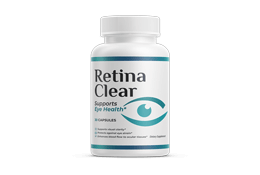
If you're researching RetinaClear before buying, the most important question is the simplest: what's actually in it, and does each ingredient have research behind it? This page walks the supplement facts panel ingredient-by-ingredient — every vitamin, mineral, and botanical, with the dose where the label discloses it and an honest note where it doesn't.
The RetinaClear Formula at a Glance
RetinaClear is a 21-ingredient daily vision formula. The label is split into two sections: named vitamins and minerals at the top (where individual doses are disclosed), and a 351 mg proprietary blend of 14 botanical ingredients and carotenoids below (where individual doses within the blend are not disclosed). This is standard practice for multi-botanical supplements — every ingredient is listed in descending order of weight, but the exact mg of each botanical isn't broken out.
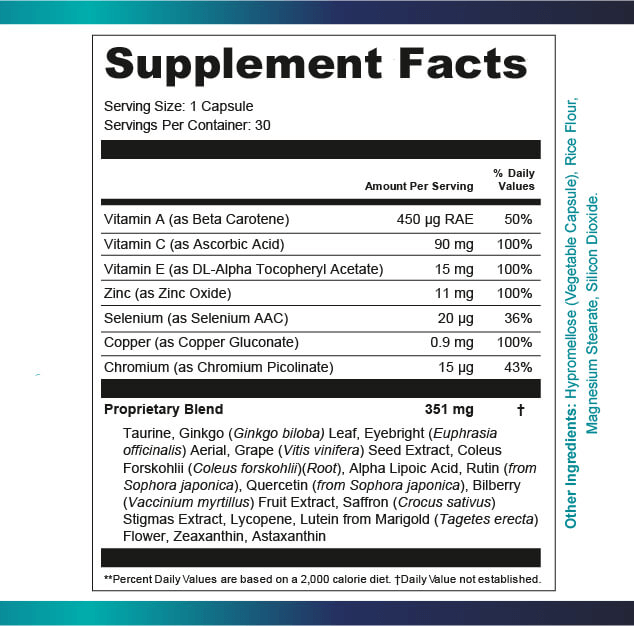 Tap image to view full-size supplement facts panel
Here is the full label, organized by category:
| Category | Ingredient | Amount / Notes |
|---|---|---|
| Vitamins | Vitamin A (as Beta Carotene) | 450 µg RAE (50% DV) |
| Vitamin C (as Ascorbic Acid) | 90 mg (100% DV) | |
| Vitamin E (as DL-Alpha Tocopheryl Acetate) | 15 mg (100% DV) | |
| Minerals | Zinc (as Zinc Oxide) | 11 mg (100% DV) |
| Selenium (as Selenium AAC) | 20 µg (36% DV) | |
| Copper (as Copper Gluconate) | 0.9 mg (100% DV) | |
| Chromium (as Chromium Picolinate) | 15 µg (43% DV) | |
| Proprietary Blend (351 mg total) | Taurine | in blend |
| Ginkgo (Ginkgo biloba) Leaf | in blend | |
| Eyebright (Euphrasia officinalis) Aerial | in blend | |
| Grape (Vitis vinifera) Seed Extract | in blend | |
| Coleus Forskohlii Root | in blend | |
| Alpha Lipoic Acid | in blend | |
| Rutin (from Sophora japonica) | in blend | |
| Quercetin (from Sophora japonica) | in blend | |
| Bilberry (Vaccinium myrtillus) Fruit Extract | in blend | |
| Saffron (Crocus sativus) Stigmas Extract | in blend | |
| Lycopene | in blend | |
| Lutein (from Marigold / Tagetes erecta Flower) | in blend | |
| Zeaxanthin | in blend | |
| Astaxanthin | in blend |
Serving size: 1 capsule daily. Servings per bottle: 30 (one-month supply).
Vitamins: A, C, and E
The three vitamins in RetinaClear form the antioxidant foundation of the formula. Each plays a documented role in age-related eye health.
Vitamin A (Beta Carotene) — 450 µg RAE
Vitamin A is essential for the production of rhodopsin, the light-sensing pigment in the rod cells of the retina that enables low-light vision. RetinaClear uses beta carotene as the source — a plant-derived precursor the body converts to vitamin A on demand, which is safer than retinyl-form vitamin A at high intakes. The dose (450 µg RAE) provides 50% of the standard adult daily value.
Vitamin C (Ascorbic Acid) — 90 mg
Vitamin C is a water-soluble antioxidant concentrated in the aqueous humor of the eye, where it helps protect ocular tissues from oxidative stress. It was a component of both the original AREDS and AREDS2 trials. The 90 mg dose in RetinaClear delivers 100% of the standard daily value (note: this is lower than the 500 mg dose used in AREDS2, but at or above general dietary adequacy).
Vitamin E (DL-Alpha Tocopheryl Acetate) — 15 mg
Vitamin E is a fat-soluble antioxidant that protects cell membranes — including the membranes of retinal photoreceptor cells — from lipid peroxidation. Vitamin E was also part of both AREDS protocols. RetinaClear provides 15 mg (100% of the standard daily value).
Minerals: Zinc, Selenium, Copper, Chromium
Zinc (Zinc Oxide) — 11 mg
Zinc is highly concentrated in the retina and is a cofactor for several retinal enzymes. The AREDS trials tested high-dose zinc (25 mg and 80 mg) in adults with intermediate AMD. The 11 mg in RetinaClear (100% daily value) is in the maintenance range — well-tolerated for daily use and aligned with general nutrient adequacy, but below the high-dose AREDS protocol.
Selenium (Selenium AAC) — 20 µg
Selenium is a trace mineral required for glutathione peroxidase, one of the body's primary antioxidant enzymes. In the eye, glutathione peroxidase activity helps neutralize peroxide damage to the lens and retina. 20 µg provides 36% of the daily value.
Copper (Copper Gluconate) — 0.9 mg
Copper is paired with zinc in supplement formulations because high-dose zinc can suppress copper absorption — supplementing both prevents that imbalance. Copper is also a cofactor for several antioxidant enzymes. 0.9 mg provides 100% of the daily value.
Chromium (Chromium Picolinate) — 15 µg
Chromium supports normal carbohydrate metabolism and insulin signaling. In the context of vision, chromium's relevance is indirect — through its role in supporting healthy blood sugar regulation, which matters because chronic blood sugar elevation is a known stressor on the retinal microvasculature. 15 µg provides 43% of the daily value.
The 351 mg Proprietary Blend
The botanical portion of the formula — 14 ingredients totaling 351 mg per capsule — is where RetinaClear extends well beyond a conventional AREDS-style formulation. The label lists these ingredients in descending order by weight, but the exact mg of each isn't disclosed (this is standard practice for proprietary blends). Below we walk through each one, grouped by function.
The 4 Carotenoids: Lutein, Zeaxanthin, Lycopene, Astaxanthin
Most vision supplements include one or two carotenoids. RetinaClear includes four — which is unusually comprehensive in the category.
Lutein (from Marigold — Tagetes erecta)
The most-studied carotenoid for age-related vision health. Lutein accumulates in the macula, where it serves as a pigment that filters high-energy blue light and as an antioxidant against ongoing oxidative stress. The AREDS2 trial conducted by the U.S. National Eye Institute used 10 mg/day of lutein from marigold in adults with intermediate AMD and found a reduced risk of progression to advanced disease (JAMA, 2013). RetinaClear uses the same marigold source. The dose within the proprietary blend is not individually disclosed.
Zeaxanthin
Lutein's structural partner — the two carotenoids occupy overlapping regions of the macula and are studied as a pair in AREDS2. Zeaxanthin is particularly concentrated in the fovea, the small central region responsible for the sharpest visual detail.
Lycopene
The red carotenoid from tomatoes and watermelon. Plays an antioxidant role in ocular tissue and has been studied for its effect on lens clarity. Lycopene is among the most efficient natural quenchers of singlet oxygen — a particularly damaging form of reactive oxygen.
Astaxanthin
Often called the "king of carotenoids" for its antioxidant potency, astaxanthin has been studied for both eye fatigue and visual accommodation (the eye's ability to focus between near and far distances). Astaxanthin is one of the few antioxidants that crosses the blood-retina barrier, which is why it's increasingly included in modern vision formulations.
Circulation & Vascular Support
Ginkgo Biloba Leaf
Ginkgo is one of the oldest medicinal botanicals in modern supplement use, primarily studied for its support of peripheral and cerebral microcirculation. In the context of eye health, ginkgo has been researched for its effect on small-vessel blood flow — including the small ocular vessels.
Grape Seed Extract (Vitis vinifera)
Grape seed extract is rich in oligomeric proanthocyanidins (OPCs), a class of flavonoids studied for their support of capillary integrity and vascular elasticity. The eye relies on an extensive network of small vessels — grape seed extract is a sensible inclusion for circulation support.
Bilberry (Vaccinium myrtillus) Fruit Extract
A small dark berry rich in anthocyanins — pigments studied for their effect on capillary integrity and night vision support. Bilberry's vision reputation dates to World War II RAF pilots who reportedly consumed bilberry jam before night missions. Modern clinical studies support its role in microcirculation and eye comfort.
Quercetin (from Sophora japonica)
A plant flavonoid with both antioxidant and capillary-stabilizing properties. A 2020 review in Antioxidants highlighted quercetin's protective effects against oxidative stress in retinal cells and its support of healthy capillary function.
Rutin (from Sophora japonica)
A flavonoid structurally related to quercetin. Rutin has been shown to reduce capillary permeability — the leakiness that can occur as small vessels age — and to reinforce vessel wall integrity. Working together with quercetin and bilberry, rutin rounds out the formula's vascular support side.
Alpha Lipoic Acid (ALA)
A uniquely versatile antioxidant — both water- and fat-soluble, allowing it to act inside cells, in the bloodstream, and across cell membranes. ALA supports retinal mitochondrial function and the endothelial cells lining the small ocular blood vessels.
Coleus Forskohlii Root
Coleus forskohlii contains forskolin, a compound studied in ophthalmology research for its effect on intraocular pressure and ocular blood flow. It's a less common inclusion in retail vision supplements and represents a more sophisticated formulation choice.
Other Botanical & Specialty Ingredients
Eyebright (Euphrasia officinalis)
An herb used in traditional European practice for centuries to soothe tired, inflamed eyes — the common name comes directly from this use. Modern phytochemistry has identified flavonoids and tannins in eyebright that exhibit anti-inflammatory and astringent properties on ocular tissue.
Saffron (Crocus sativus) Stigmas Extract
Saffron is the most-studied "modern" addition to vision supplements. Clinical work on saffron extract — particularly its compounds crocin and crocetin — has examined its effect on retinal function and macular health. Saffron's inclusion in RetinaClear is one of the most distinguishing aspects of the formula relative to older vision products.
Taurine
Taurine is the most abundant amino acid in the retina. It plays roles in photoreceptor membrane stability and osmoregulation in retinal cells. Taurine deficiency in animal studies is associated with retinal degeneration, which is why it appears in modern eye-health formulations.
Inactive Ingredients (Capsule & Fillers)
RetinaClear's "other ingredients" list (the non-active components) is short and clean:
- Hypromellose — vegetable-based capsule shell. This is why RetinaClear is vegan-friendly.
- Rice Flour — common natural filler.
- Magnesium Stearate — flow agent used in capsule manufacturing.
- Silicon Dioxide — anti-caking agent.
No artificial colors, no synthetic flavors, no added sugar.
The Official Label Claims
Per the supplement facts panel, RetinaClear is marketed with three structure-function claims (FDA-permitted language for dietary supplements):
- Supports visual clarity*
- Protects against eye strain*
- Enhances blood flow to ocular tissues*
*These statements have not been evaluated by the Food and Drug Administration. This product is not intended to diagnose, treat, cure, or prevent any disease.
Suggested Use & Cautions (from the label)
- Suggested use: As a dietary supplement, take one (1) capsule daily.
- Caution: Do not exceed recommended dose. Not for use by those under the age of 18, or pregnant/nursing mothers. Consult with a physician prior to use, especially if you are taking medication or have a medical condition.
- Storage: Store in a cool, dry place below 30°C (86°F).
Manufacturer
RetinaClear is manufactured for Natures Formulas, Aurora, CO 80011, USA, in a GMP-certified facility. Customer support: [email protected] · 1-888-696-0597.
See Today's Pricing on the Official Site
The 6-bottle package ($49/bottle) is the most popular option — it covers the 90+ days needed to fairly evaluate carotenoid supplementation.
→ Visit the Official RetinaClear WebsiteWant our complete take? Read the full RetinaClear review or our "Does RetinaClear actually work?" analysis.
Frequently Asked Questions
What are the ingredients in RetinaClear?
RetinaClear contains 21 active ingredients. The named portion of the label includes 7 vitamins and minerals: vitamin A (450 µg RAE as beta carotene), vitamin C (90 mg), vitamin E (15 mg), zinc (11 mg), selenium (20 µg), copper (0.9 mg), and chromium (15 µg). The product also contains a 351 mg proprietary blend of 14 botanicals and carotenoids: taurine, ginkgo biloba leaf, eyebright, grape seed extract, coleus forskohlii root, alpha lipoic acid, rutin, quercetin, bilberry fruit extract, saffron, lycopene, lutein (from marigold), zeaxanthin, and astaxanthin.
Does RetinaClear contain lutein and zeaxanthin?
Yes. RetinaClear contains lutein (sourced from marigold/Tagetes erecta flower) and zeaxanthin as part of its 351 mg proprietary botanical blend. The blend also includes two additional carotenoids — lycopene and astaxanthin — giving the formula four carotenoids in total, more than most vision supplements.
Does RetinaClear use a proprietary blend?
Yes. The 14 botanical ingredients in RetinaClear are listed within a 351 mg proprietary blend, which means individual doses within the blend are not disclosed. This is standard practice for multi-botanical formulations. The 7 vitamins and minerals at the top of the label are individually dosed with full transparency.
Are RetinaClear ingredients safe?
The 21 ingredients in RetinaClear all have well-established safety profiles at typical supplement doses. The vitamin and mineral doses are at or below 100% of the standard daily value. The product is manufactured in a GMP-certified U.S. facility. Anyone taking blood thinners, blood pressure medication, or diabetes medication should consult their healthcare provider before starting any new supplement.
Is RetinaClear vegan?
Yes. RetinaClear uses a vegetable hypromellose capsule and the active ingredients are plant- and mineral-derived. Inactive ingredients are limited to hypromellose (capsule), rice flour, magnesium stearate, and silicon dioxide.
How does RetinaClear compare to AREDS2?
RetinaClear is built around the carotenoid pair studied in AREDS2 (lutein and zeaxanthin) but takes a much broader approach — adding 12 additional botanical compounds plus the antioxidant carotenoids lycopene and astaxanthin, and including vitamins A, C, E and trace minerals (zinc, copper, selenium, chromium). The individual lutein and zeaxanthin doses inside the proprietary blend aren't disclosed, so it's not strictly dose-equivalent to AREDS2 — but the formulation is significantly more comprehensive in ingredient count.
Scientific References
This page cites the following authoritative sources. All links open in a new tab. Sources are categorized by ingredient or topic.
Lutein, Zeaxanthin & the AREDS Trials
- National Eye Institute. Age-Related Eye Disease Studies (AREDS / AREDS2). nei.nih.gov.
- AREDS2 Research Group. Lutein + zeaxanthin and omega-3 fatty acids for age-related macular degeneration: the AREDS2 randomized clinical trial. JAMA. 2013;309(19):2005-2015. PubMed.
- AREDS Research Group. A randomized, placebo-controlled clinical trial of high-dose supplementation with vitamins C and E, beta carotene, and zinc for AMD and vision loss: AREDS report no. 8. Arch Ophthalmol. 2001;119(10):1417-1436. PubMed.
- Buscemi S, et al. The effect of lutein on eye and extra-eye health. Nutrients. PMC6164534.
- van der Made SM, et al. Increased macular pigment optical density and visual acuity following consumption of a buttermilk drink containing lutein-enriched egg yolks: a randomized, double-blind, placebo-controlled trial. PMC4808677.
- Bernstein PS, et al. The photobiology of lutein and zeaxanthin in the eye. PMC4698938.
- American Macular Degeneration Foundation. Study demonstrates essential role of zeaxanthin in eye health. macular.org.
- Parisi V, et al. Carotenoids and antioxidants in age-related maculopathy Italian Study (CARMIS): multifocal electroretinogram modifications after 1 year. Ophthalmology. PubMed 17716735.
Astaxanthin & Vision
- Nakamura A, et al. Changes in visual function following peroral astaxanthin. ResearchGate.
- Research on astaxanthin, eye fatigue, and visual accommodation. PubMed search.
Other Botanicals (Eyebright, Bilberry, Quercetin, Saffron, ALA)
- Paduch R, et al. Assessment of eyebright (Euphrasia officinalis L.) extract activity in relation to human corneal cells using in vitro tests. PMC4115993.
- Research on bilberry (Vaccinium myrtillus) anthocyanins and vision. PubMed search.
- Research on quercetin and retinal oxidative stress. PubMed search.
- Research on saffron (Crocus sativus) and age-related macular function. PubMed search.
- Research on alpha lipoic acid and retinal mitochondrial function. PubMed search.
General Vision Health & Reference
- National Institutes of Health, Office of Dietary Supplements. Carotenoids — Health Professional Fact Sheet. ods.od.nih.gov.
- National Institutes of Health, MedlinePlus. Age-related macular degeneration overview. medlineplus.gov.
Disclaimer: The statements on this website have not been evaluated by the FDA. These products are not intended to diagnose, treat, cure, or prevent any disease. Individual results may vary. Content on this page is for educational purposes only and is not a substitute for professional medical advice.
Affiliate disclosure: This page contains affiliate links. We may earn a commission if you purchase through our links, at no extra cost to you.